
Overview of Speciality Training in the UK


Postgraduate and speciality or GP training in the UK is the most important and penultimate step of a doctor in their career. It’s every doctor’s dream to be trained in some specific speciality, maybe in some specific region too. Life starts to get complicated with responsibilities and priorities regarding family and all when you reach that age, and that’s how a lot of other factors start influencing the career choice too. That’s why I would suggest gathering as much information as you can before you reach that point.
Where is the start of the training as doctor in the UK?
A doctor’s training or residency in the UK is separated roughly in three levels.
- Foundation training
- Core level training
- Higher Speciality training
So, a UK medical graduate starts from the 2 years foundation training. Upon finishing that, they apply and get into a 2/3 years core level training in a desired speciality. After that, they again apply and get into 4/5/6 years of speciality training (sub speciality included) in the UK (depending on the speciality).
But, an International Medical Graduate who gets full GMC registration with a licence to practice doesn’t HAVE to go through the foundation training in the UK. They can start at an equivalent level in the non-training side and get the required competencies signed off and proceed onto doing core level training. Sounds complicated? Read on!
Find out ways an International Medical Graduate can get full GMC registration – How to get registered with GMC.
If you are an EU/EEA graduate, you may be eligible for provisional or full GMC registration based on the country you graduated from. You are also exempt from any exams aside from potentially requiring an English language proficiency exam.
Have Provisional Registration?
If you've not completed an acceptable pattern of internship abroad, you can (and should, in our opinion!) apply for the UK foundation program. This is their internship which allows you to start in the UK from the very beginning.
What is a training job vs non-training job?
The Local Education and Training Boards (LETBs) / the deaneries, who control the training of doctors around the UK, can only accommodate specific number of trainees round the year (those are training jobs) but the trusts/hospitals need more doctors. That’s why there are jobs for doctors which are termed as non-training. These jobs will give you work experience, but not count towards any formal training.
These are the kind of jobs an IMG generally ends up taking as their first job. And these non-training jobs also run along with the trainee level, e.g. FY2 level non-training, CT level non-training. The responsibilities are quite the same as a trainee, but trainees have a curriculum to go through, whereas non-training are basically doing a service job.
During these non-training jobs you can get your required competencies signed if you prove yourself up to that level and thus apply for training when the application rounds open. You do get paid the same as a trainee of your level.
We will be talking about competencies in a while.
Levels of Doctors in the NHS
Before commencing the discussion of the complete training structure let’s talk about some terminology. The levels of doctors have shortened form.
| Levels of doctors in the UK | What do they mean |
|---|---|
| Foundation year 1 (F1 or FY1) | Internship or Housejob |
| Foundation year 2 (F2 or FY2) | UK’s internship – in many countries these position is also termed as “medical officer” or the junior doctor of the hospital |
| Core Trainee / Internal Medicine Trainee / GP Trainee (CT – IMT – ST 1/2/3) | Junior trainee (resident) doctors in specific specialty |
| Specialty Trainee (ST3+) | Senior trainee (fellow) doctors in specific specialty |
Now these are trainee levels. How the non-trainee are termed?
All the non-trainee posts are now advertised with their corresponding trainee level so that it’s easier to understand the job description and the modernised level. Still some terminologies for junior doctors are:
- SHO (Senior House Officer) [FY2 or CT1 level]
- Trust Grade doctor [FY2 or CT1 level]
- Junior clinical fellow [FY2 or CT1 level]
And some terminologies for higher grade doctors are:
- Speciality Registrar [ST3 or up]
- Senior clinical fellow [ST3 or up]
There is another higher group of non training doctors, they are termed SAS (Speciality and Associate Specialist) doctors. These are non-training roles where the doctor has at least four years of postgraduate training, two of those being in a relevant speciality.
SAS doctors are usually more focused on meeting NHS service requirements, compared to trainee or consultant roles. In the job advertisements, they are generally termed as Speciality doctor.
My take on the terminologies is to understand the modernised (FY1/2 CT1/2) levels first and then ask whatever level the job is. If you are looking for non-training jobs and finding it hard to understand the levels – read more here – How to find a job in the NHS
Training in Medical & Surgical Specialities
Foundation training
The 2 years foundation training by UKFPO is the “internship” equivalent in the UK. If an IMG has completed an acceptable pattern of internship as discussed here, GMC approved internship and UKFPO foundation training, they don’t need foundation training by UKFPO. Still, you can apply for standalone F1/F2 LAT post, which will make your transition into further training easier.
What is Locum appointment for training (LAT) vs Locum appointment for service (LAS)?
LAT stands for Locum Appointment for Training. LAS is Locum Appointment for Service. By definition, “locum” means a person who stands in temporarily for someone else of the same profession.
Someone may have dropped out of their training, LAT fills that. Hospitals need to fill up some gaps temporarily, LAS fills that. So, an LAT job is a training job, but temporary. On the other hand, LAS is a non-training job and also fixed contract i.e. temporary. Please do not confuse the “BANK doctor” job with LAS jobs. LAS jobs are fixed term basis locum jobs where bank jobs are hourly basis jobs. As an IMG, it’s not wise to start off with a hourly basis bank type locum job as you wouldn’t have that much support.
During these non-training jobs you can get your required competencies signed and thus apply for training when the application rounds open.
Core Level Training
This is the start of speciality training in the UK after successful completion of the foundation training. Whether or not your core training will be continuous with your speciality training, it depends on the speciality you are going to pursue. One of the first things you need to understand is if your speciality is run-through or uncoupled. Now, what does that mean?
If it’s run-through:
- The training starts at ST1. Core training is not separate from the speciality training.
- You can gain entry from ST1-ST4 level depending on your experience, competencies, and their vacancies.
If it’s uncoupled:
- Core level training is separate from the higher speciality training.
- Either you’ll have to finish core training in the UK or have your core competencies signed before you can apply at ST3/4 level, where this speciality training starts.
Remember that some specialties need the MSRA exam before you can apply, while others are content with just conducting interviews.
Which specialities are run-through? Which specialities are uncoupled?
Now we know what must be running through your mind: which specialities are run-through and which are uncoupled? Good question. Let’s break it down.
| Run-through | Uncoupled |
|---|---|
| Cardio-thoracic surgery | Acute internal medicine |
| Clinical radiology | Allergy |
| General Practice (GP) | Anaesthetics |
| Histopathology | Audio-vestibular medicine |
| Neurosurgery | Cardiology |
| OB/GYN | Clinical oncology |
| Oral and maxillo-facial surgery | Gastroenterology |
| Pediatrics | Dermatology |
| Geriatric medicine | |
| Hematology | |
| Neurology | |
| Otolaryngology | |
| Plastic surgery | |
| General Surgery | |
| Renal medicine | |
| Rheumatology | |
| Urology |
This list is not exhaustive, we’ve just made mention of certain specialities that are most often sought after and asked about.
Alternative pathways to Core Training
There are other alternative pathways to core training like ACCS (for anaesthesia, emergency and acute medicine) and Broad Based Training (CMT, GP, Paediatrics, Psychiatry) before getting into ST3/4 onwards.
Higher Speciality Training
This is the final step of the training. As mentioned earlier, the training is separate in case of uncoupled specialities, but it’s continuous in run-through speciality.
After ST5 or somewhere in between (depending on the speciality), Speciality Certificate examinations will be held. Upon finishing the rest of the training certificate of completion of training (CCT) can be obtained thus enabling to get entry into the specialist register and work as a consultant.
Subspecialty Training
Subspecialties are also a part of this section of the training. It can be taken at ST3 level onwards or maybe after ST6 onwards, depends on the speciality. I’m talking about subspecialties like Paediatric oncology/nephrology (Paediatrics), Maternal and fetal medicine (OBGYN), Hepatology (Gastroenterology), Stroke medicine (Cardiology, Acute internal medicine, Neurology).
Are there any exams to enter core/speciality training?
Yes and no. When most of the specialties don’t need exams to get into, just application in Oriel (thus being eligible first, according to the criteria set for core/specialty training) then interview and then the whole recruitment process, some medical & surgical specialties DO NEED an exam to get into training. These are:
- Radiology
- Ophthalmology
- Obstetrics and Gynaecology
- ACCS-EM
- Core Psychiatry
- General Practice
- Neurosurgery
- Core Surgical
- Anaesthetics
- Nuclear M
- Community Sexual and Reproductive Health
The exam that is held for these specialties is called Multi-Specialty Recruitment Assessment (MSRA). To know further about this exam, please check the official page.
Can I apply for speciality training right after passing PLAB?
Yes! Many IMGs have done so, and continue to do so. What you need to ensure if this is your plan is that you meet the criteria to apply, and that you are diligent in creating the portfolio required.
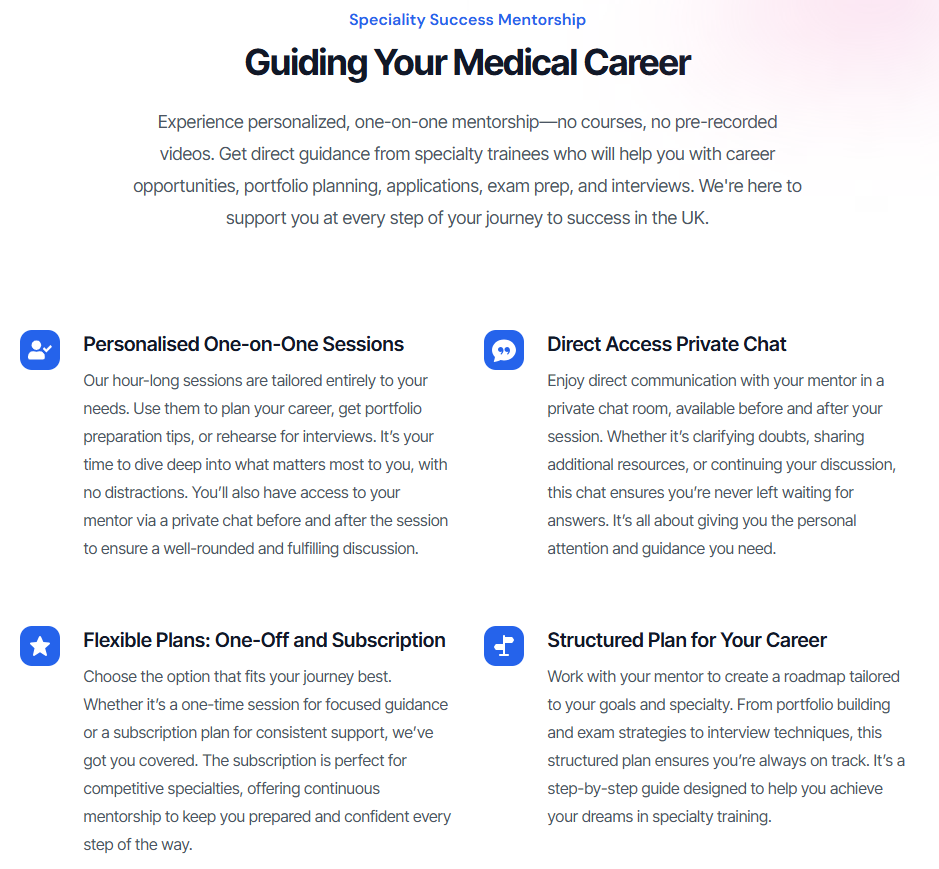
If you need support from IMGs who have managed it before you, you'll be please to know that we offer a speciality success mentorship where you can get the complete guidance you need, from portfolio building to interview preparation.
Remember that some training programs may require partial or complete membership exams to apply!
Postgraduate Degree vs Postgraduate Training
A lot of people asks about what postgraduate degree they will get after completing the training or residency in the UK. To answer this question, you have to know what exams are integrated in the specific training pathway and how the training pathway is structured.
Training curriculum are made by the respective Royal Colleges and approved by GMC. So, when you complete a GMC-approved training/residency, you receive a Certificate of Completion of Training (CCT). With that certificate, you can register as a Specialist under GMC and will be able to take up consultant jobs in the UK.
But CCT is not a PG degree, it’s a recognition of your successful completion of an approved training. Some PG degrees are integrated in this curriculum.
For example, in the dermatology training pathway – you have to take MRCP as a part of core level training (Internal Medicine Training) and then SCE Dermatology to successfully complete the dermatology training. For Neurosurgery training pathway in the UK, you will have to complete both MRCS and FRCS (Neurosurgery) as a part of your training. So, you end up getting these PG degree/qualifications at the end of your PG training.
If you are still confused – watch this explanatory video by Dr Ibreez Ajaz.
サイズ表を見るだけでなく、自分の採寸と着用したい余裕を合わせて考えると選びやすくなります。イベント用の準備を整えるなら、スペースエレシュキガル キャラクター衣装を確認して不足しそうな要素を把握できます。小物や靴との組み合わせを考えると、衣装全体の完成度を高めやすくなります。
Frequently asked questions
How can I be [this] specialist in the UK? Can you tell me the training pathway of [this] specialty?
Am I eligible to apply for [this] training?
When and how do I apply for training?
How difficult it is to get into training of [this] speciality? How many posts are there?
Is there any tuition fees for speciality training in the UK?
Wrapping Up
- The very first thing you need as an IMG is GMC registration, which can be provisional or full.
- Job in the NHS as a doctor can be non-training or training.
- Non-training jobs gives a very good opportunity to acclimatize to a new system and enrich your portfolio to apply for your desired speciality training.
- The duration of training or residency in the UK varies from speciality to speciality. In general, the entire training can last from 3 to 8 years.
A sound idea about what’s ahead is always needed to succeed in life. Training/residency in the UK is longer in comparison to other countries, especially the USA. However, the opportunity to hold non-training jobs and fewer restrictions to apply for training posts (compared to matching in the USA) are plus points for IMGs who make a big transition from their homeland to a foreign land. At the end of the day, it’s you who will choose what’s ideal for you.